
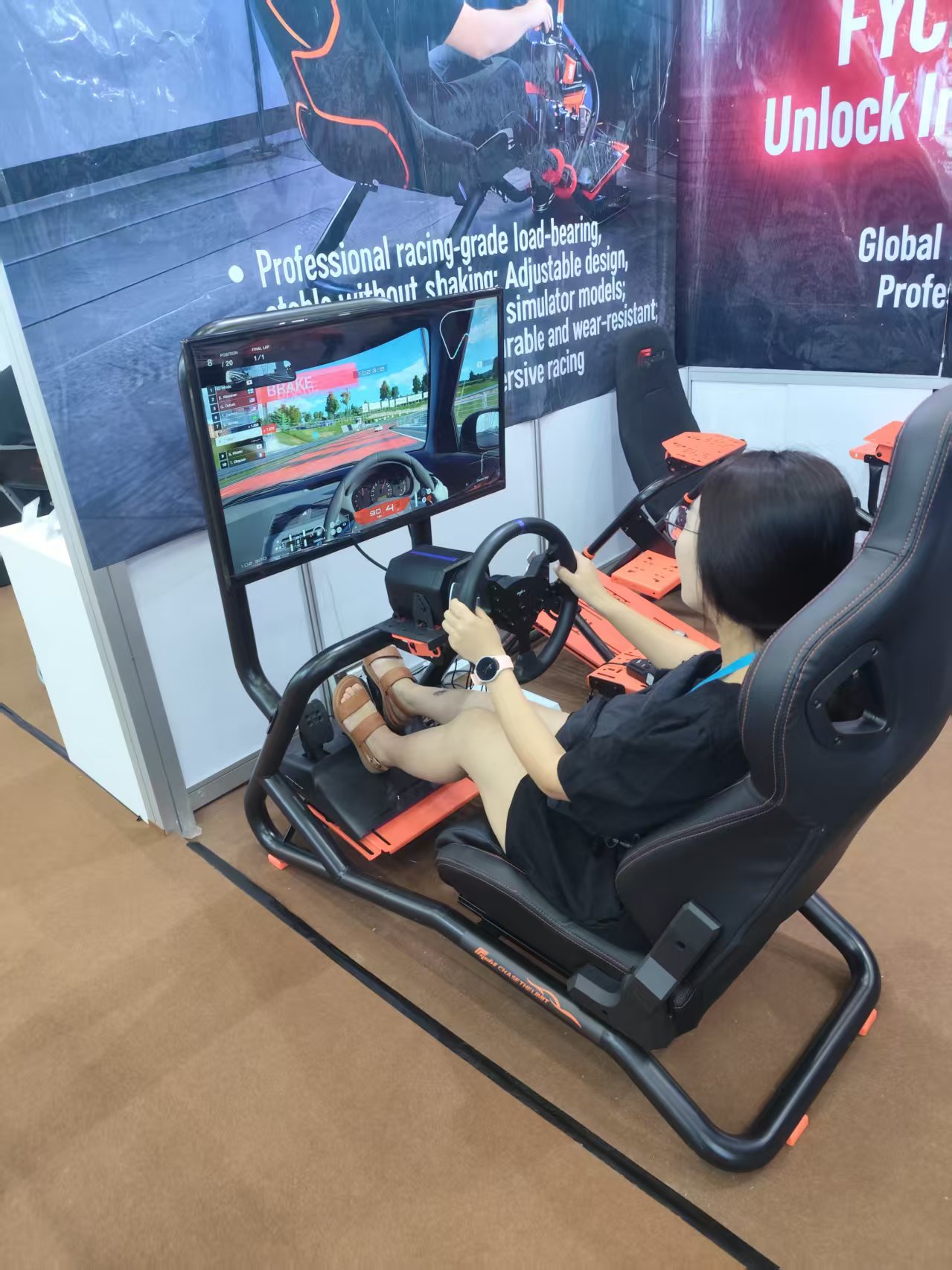
For five days at the Canton Fair, the FYCHI booth never felt empty.
Not because of a massive setup or fancy decorations. Because everyone who walked by couldn’t resist sitting down and trying it for themselves.
Tee, an esports distributor from Thailand, came by on the third morning. He was just passing by — until he saw the folding mechanism in action. He stopped. With a quick guide from our team, he sat in the cockpit, adjusted the seat, pressed the throttle and brake, and turned the wheel through a few counter-steer motions. When he got out, he said: “I‘ve only sold steering wheels and seats. I never considered selling rigs before — they take up too much space, and customers struggle with assembly. But your foldable model makes me rethink that.”
Anna, a racing equipment wholesaler from Poland, has been in the automotive accessories industry for twelve years. She sells steering wheels, pedals, and seats — but never rigs. In her view, rigs take up too much warehouse space and come with too many customer assembly headaches. She came to the FYCHI booth with a “just looking” mindset.
Anna started by pressing her finger against the aluminum profile cross-section, then ran her fingernail across the welds — her usual quality check. Then she opened and closed the folding mechanism, pushing and pulling five times. She looked up and asked: “What‘s the wall thickness of this aluminum? Are the welds done by hand or machine?”
After receiving the answers, Anna sat in the cockpit. She pressed the pedals, turned the wheel, and simulated several corners. When she got out, she was direct: “I haven’t sold rigs before because everything on the market is either too expensive or too flexible. Yours sits in the middle — rigid enough, priced within my range. Send me a trial quote. I want a few units for my existing customers to test.”
As she left, she turned back and added: “If they buy, I‘ll sign.”
A buyer from Saudi Arabia tested the folding mechanism repeatedly. Before leaving, he said something that stayed with us: “I don’t like ordering from pictures online. I need to touch it. See it. Then I‘ll sell it to my customers. You let me touch it. So I’ll try it.”
These moments cannot be scripted.
What the FYCHI team did most at the booth was not “presenting features” — it was folding the rig, unfolding it, folding it again. Letting buyers inspect the welds themselves. Run their fingers along the edges. Step on the pedals. The sentence we heard most after the experience was: “This works. How do I order?”
FYCHI believes a good product speaks for itself. And Canton Fair was where it found its voice.